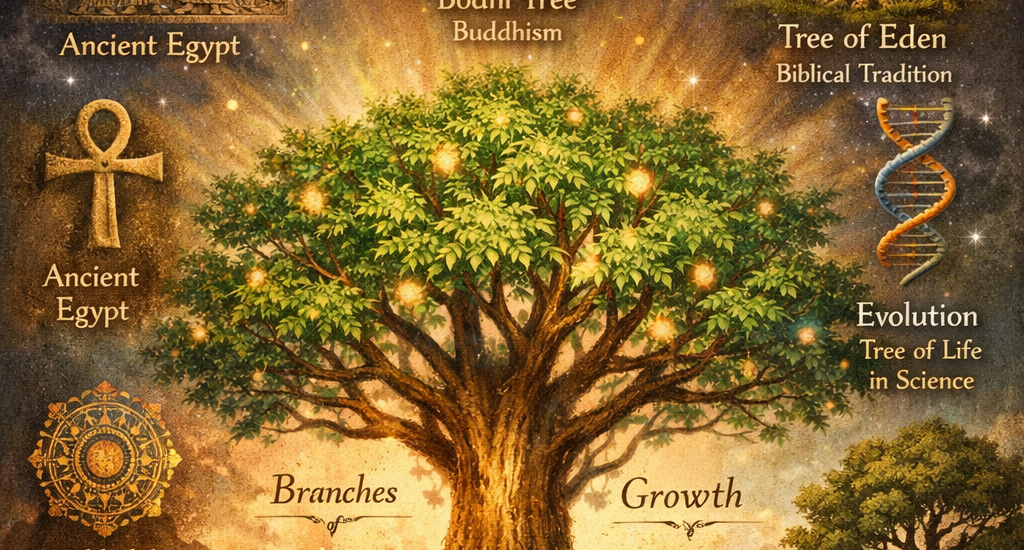
The phrase “Tree of Life” is one of those ideas that seems to show up everywhere. It appears in religion, mythology, philosophy, science, and art. Sometimes it is a sacred symbol. Sometimes it is a way of explaining how all living things are connected. And sometimes it simply stands for growth, strength, and renewal. Even though different cultures describe it in different ways, the core idea stays surprisingly similar: life is interconnected.
A Symbol Found Across Cultures
The Tree of Life has appeared in human thought for thousands of years. In many traditions, it represents the link between heaven, earth, and the underworld. Its roots go deep into the ground, its trunk stands in the human world, and its branches reach upward. Because of this structure, people often saw it as a bridge between different realms of existence.
In ancient Mesopotamia, sacred tree imagery appeared in carvings and myths. In Egyptian belief, trees were sometimes connected to divine protection and eternal life. In Norse mythology, the great ash tree Yggdrasil held the universe together, connecting different worlds. In Hindu and Buddhist thought, the tree can symbolize wisdom, enlightenment, and the cycle of life. In the Bible, the Tree of Life appears in the Garden of Eden as a source of eternal life.
What is fascinating is that these traditions developed in different places and times, yet many arrived at a similar image. A tree was not just a plant. It became a model for understanding existence itself.
Why a Tree?
A tree is a powerful symbol because it reflects life in a very visible way. It begins as a tiny seed, grows over time, survives storms, changes with the seasons, and can live far longer than a human being. It also gives shelter, fruit, shade, and oxygen. In that sense, a tree supports life while also being alive itself.
Its shape also matters. Roots suggest origin and ancestry. The trunk suggests stability and strength. Branches suggest diversity, possibility, and expansion. Leaves and fruit suggest renewal and the continuation of life. All of that makes the tree a natural symbol for both personal growth and the larger pattern of life on earth.
The Tree of Life in Religion and Spiritual Thought
In spiritual traditions, the Tree of Life often carries deep meaning. It can symbolize immortality, divine wisdom, balance, or the unity of creation.
In Judaism, the Tree of Life can refer both to the biblical tree in Eden and, in mystical thought, to a symbolic structure representing divine attributes and the path toward spiritual understanding. In Christianity, it is associated with eternal life and redemption. In Islam, trees also appear as important spiritual symbols, connected with paradise, knowledge, and divine mercy.
In Buddhism, the Bodhi Tree is especially important because it is the tree under which Siddhartha Gautama attained enlightenment and became the Buddha. Here, the tree becomes a place of awakening. In Hindu tradition, the sacred fig tree and the upside-down cosmic tree symbolize the universe and the relationship between the material and spiritual worlds.
Across these traditions, the Tree of Life is rarely just decoration. It is a statement about what life means and where human beings belong within a larger order.
A Scientific Meaning
The Tree of Life is not only a spiritual or cultural symbol. It also has a scientific meaning. In biology, the “tree of life” refers to the evolutionary relationship among all living organisms. Scientists use tree-like diagrams to show how species are connected through common ancestry.
This idea became especially important after Charles Darwin. Evolution suggested that all species are related in some way, branching over time from earlier forms of life. In this sense, the tree of life is not symbolic alone. It is a map of biological history.
Humans, animals, plants, fungi, and microorganisms are all part of one immense living network. The scientific tree of life shows that life is diverse, but not separate. Every branch comes from the same deeper roots.
That idea can feel almost poetic. Ancient cultures imagined that all life was connected, and modern science, in its own way, confirms that connection.
The Tree of Life in Art and Modern Culture
The Tree of Life continues to appear in paintings, jewelry, architecture, literature, tattoos, and films. People are drawn to it because it feels timeless. It can represent family, ancestry, healing, rebirth, or inner peace.
In family history, a “family tree” is really a version of the Tree of Life, showing how generations branch out from common ancestors. In psychology and self-help, the image is often used to suggest emotional grounding and personal development. In environmental thought, it can stand for the fragile but beautiful web of life that humans must protect.
Its meaning can be deeply personal too. For one person, it may symbolize faith. For another, resilience after hardship. For another, the bond between all living beings.
Why It Still Matters
The Tree of Life remains meaningful because it speaks to something basic in human experience. People want to understand where they come from, how they are connected to others, and what gives life meaning. The tree offers a simple but rich answer: life grows, changes, branches out, and remains connected at its roots.
In a world that often feels divided, the Tree of Life is a reminder of unity. In times of struggle, it suggests endurance. In times of change, it suggests growth. And in both ancient stories and modern science, it tells us that life is not random fragments, but a living whole.
Conclusion
The Tree of Life is more than a symbol from old myths. It is an idea that continues to speak across cultures, religions, and even scientific thought. Whether seen as a sacred tree, a cosmic map, or an emblem of human growth, it points to the same truth: all life is linked.
That may be the reason the symbol has lasted so long. A tree stands firm, reaches upward, and grows outward, all while staying rooted. In much the same way, human life is strongest when it remembers both its roots and its connections.