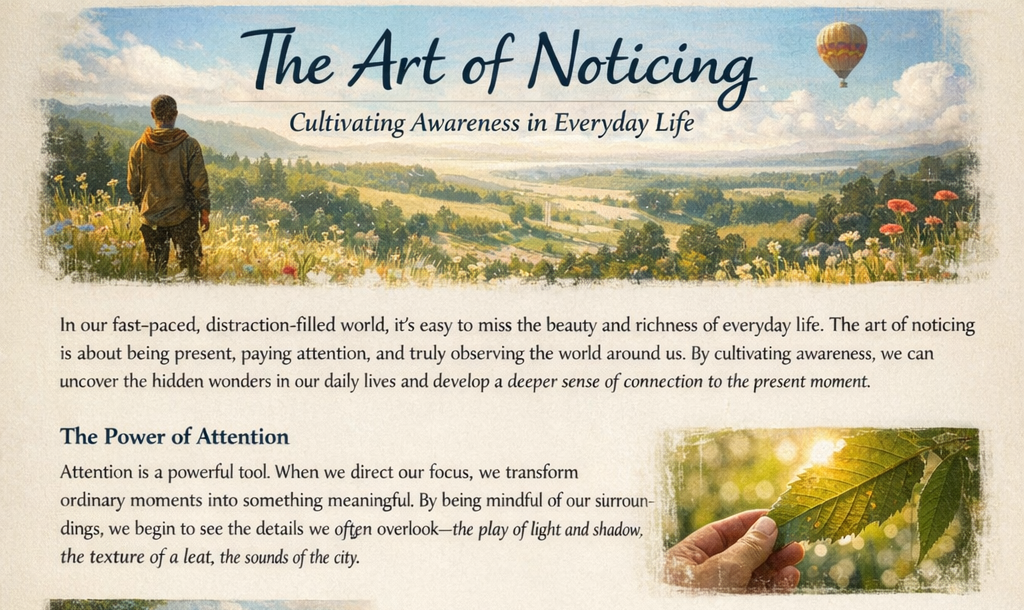
In a world that moves at an ever-accelerating pace, where notifications buzz, deadlines loom, and attention is constantly divided, the simple act of noticing has become both rare and powerful. We rush from one task to another, often unaware of the subtle beauty and meaning woven into our everyday lives. The art of noticing is about reclaiming that awareness. It is the practice of paying attention—intentionally, curiously, and without judgment—to the world around us.
Noticing is not merely seeing. It is a deeper engagement with reality. It asks us to slow down, to observe details, to become present. It transforms ordinary experiences into meaningful ones and allows us to connect more fully with ourselves, others, and our surroundings.
The Power of Attention
Attention is one of the most valuable resources we possess. Where we place it shapes our experience of life. When we operate on autopilot, days blur together. We perform routines without reflection, missing the richness of each moment. However, when we consciously direct our attention, even the simplest experiences can become vivid and memorable.
Consider walking down a familiar street. Most of the time, you might pass through it without a second thought. But if you truly notice—observe the shifting patterns of light, the expressions of people passing by, the sounds layered in the environment—the same street becomes alive with detail and meaning. Attention transforms the mundane into something extraordinary.
Why We Stop Noticing
Modern life often discourages noticing. Technology, while useful, fragments our focus. Social media, constant connectivity, and information overload train us to skim rather than observe deeply. We become conditioned to seek stimulation rather than presence.
Additionally, routine dulls perception. When something becomes familiar, we stop paying attention to it. This is why people often overlook the beauty in their daily environments—they assume they already know what is there.
Another factor is mental preoccupation. Worries about the future or regrets about the past can consume our thoughts, leaving little room for awareness of the present moment. As a result, life is experienced indirectly, filtered through distraction and habit.
The Benefits of Noticing
Practicing the art of noticing has profound benefits for both mental and emotional well-being.
First, it reduces stress. When we focus on the present moment, we step away from the anxieties of what might happen or what has already occurred. This creates a sense of calm and grounding.
Second, noticing enhances creativity. Artists, writers, and innovators often draw inspiration from careful observation. By paying attention to details, patterns, and nuances, we open ourselves to new ideas and perspectives.
Third, it deepens relationships. When we truly notice others—their expressions, tone, and emotions—we become more empathetic and connected. People feel seen and valued when they are genuinely observed.
Finally, noticing increases gratitude. When we become aware of small joys—a warm cup of tea, a gentle breeze, a kind gesture—we begin to appreciate life more fully. Gratitude grows not from grand events but from the accumulation of noticed moments.
Slowing Down: The First Step
To notice, we must first slow down. This does not necessarily mean changing our entire lifestyle, but rather adjusting how we move through our day.
Slowing down can be as simple as pausing between tasks, taking a few deep breaths, or walking at a slightly more relaxed pace. It involves creating small pockets of stillness where awareness can emerge.
For example, instead of rushing through a meal, take time to observe the colors, textures, and flavors of the food. Instead of scrolling through your phone while waiting, look around and take in your surroundings. These small shifts can significantly enhance your ability to notice.
Engaging the Senses
One of the most effective ways to cultivate noticing is by engaging the senses. Our sensory experiences anchor us in the present moment.
- Sight: Observe colors, shapes, shadows, and movement. Notice how light changes throughout the day.
- Sound: Listen to layers of noise—the hum of traffic, birds chirping, distant conversations.
- Touch: Feel textures, temperatures, and physical sensations.
- Smell: Pay attention to subtle scents in the environment.
- Taste: Savor food slowly, noticing flavors and changes with each bite.
By consciously engaging the senses, we shift from thinking about life to experiencing it directly.
Finding Beauty in the Ordinary
We often associate beauty with rare or extraordinary experiences—sunsets, mountains, celebrations. However, the art of noticing reveals that beauty exists everywhere, even in the most ordinary settings.
A raindrop sliding down a window, the rhythm of footsteps on a street, the quiet moment before sunrise—these are not dramatic events, yet they carry a quiet richness. When we begin to notice such details, life feels fuller and more meaningful.
This shift in perception is transformative. Instead of constantly seeking something new or exciting, we begin to find satisfaction in what already exists around us.
Noticing People and Emotions
The art of noticing extends beyond the physical world into human interactions. Every person we encounter carries a story, emotions, and experiences that are often overlooked.
Noticing people involves observing their expressions, listening carefully to their words, and being present in conversations. It means paying attention not just to what is said, but how it is said.
This practice fosters empathy. When we notice subtle emotional cues, we become more attuned to others’ needs and feelings. Relationships become deeper and more authentic because they are built on genuine awareness rather than assumption.
The Role of Curiosity
Curiosity is at the heart of noticing. When we approach the world with a sense of wonder, we naturally become more attentive.
Children are excellent noticers because they are curious. They ask questions, explore, and engage deeply with their environment. As adults, we often lose this curiosity, replacing it with familiarity and assumption.
Reclaiming curiosity means allowing yourself to be surprised. Ask simple questions: Why does this look the way it does? What is happening here that I’ve never noticed before? This mindset turns everyday life into a continuous exploration.
Journaling and Reflection
Writing can enhance the practice of noticing. Keeping a journal of observations encourages you to pay closer attention throughout the day.
You might write about something you saw, heard, or felt that stood out. It doesn’t have to be significant—what matters is that you noticed it.
Reflection deepens awareness. When you revisit these observations, you begin to see patterns and develop a greater appreciation for the richness of your experiences.
Overcoming Challenges
Practicing the art of noticing is not always easy. Distractions, habits, and time pressures can make it difficult to stay present.
One common challenge is impatience. We often feel the need to move quickly, to accomplish tasks efficiently. Noticing requires a shift in priorities—from speed to presence.
Another challenge is mental clutter. Thoughts can dominate our attention, pulling us away from the present moment. In such cases, gently redirecting focus to the senses can help.
It is important to approach noticing without pressure. It is not about perfection but practice. Even brief moments of awareness can make a difference.
Making Noticing a Habit
To integrate noticing into daily life, start small. Choose specific moments to practice—during a walk, while eating, or before going to sleep.
You might set a simple intention each day: to notice three things you usually overlook. Over time, this practice becomes natural, and awareness begins to expand.
Consistency matters more than intensity. A few mindful moments each day can gradually transform how you experience life.
A Different Way of Living
The art of noticing is more than a technique; it is a way of living. It shifts the focus from doing to being, from rushing to experiencing.
When you notice, time feels different. Moments become fuller, richer, and more meaningful. Life is no longer something that passes by unnoticed but something you actively engage with.
In this way, noticing becomes a quiet form of appreciation. It allows you to recognize the value of what is already present, rather than constantly seeking something more.
Conclusion
In a distracted world, noticing is a radical act. It requires intention, patience, and a willingness to slow down. Yet its rewards are profound.
By practicing the art of noticing, we reconnect with the present moment. We discover beauty in the ordinary, deepen our relationships, and cultivate a sense of gratitude. Life becomes less about chasing experiences and more about experiencing what is already here.
Ultimately, noticing reminds us that meaning is not hidden in distant achievements or future goals. It is found in the small, quiet moments that surround us every day—waiting, patiently, to be seen.